

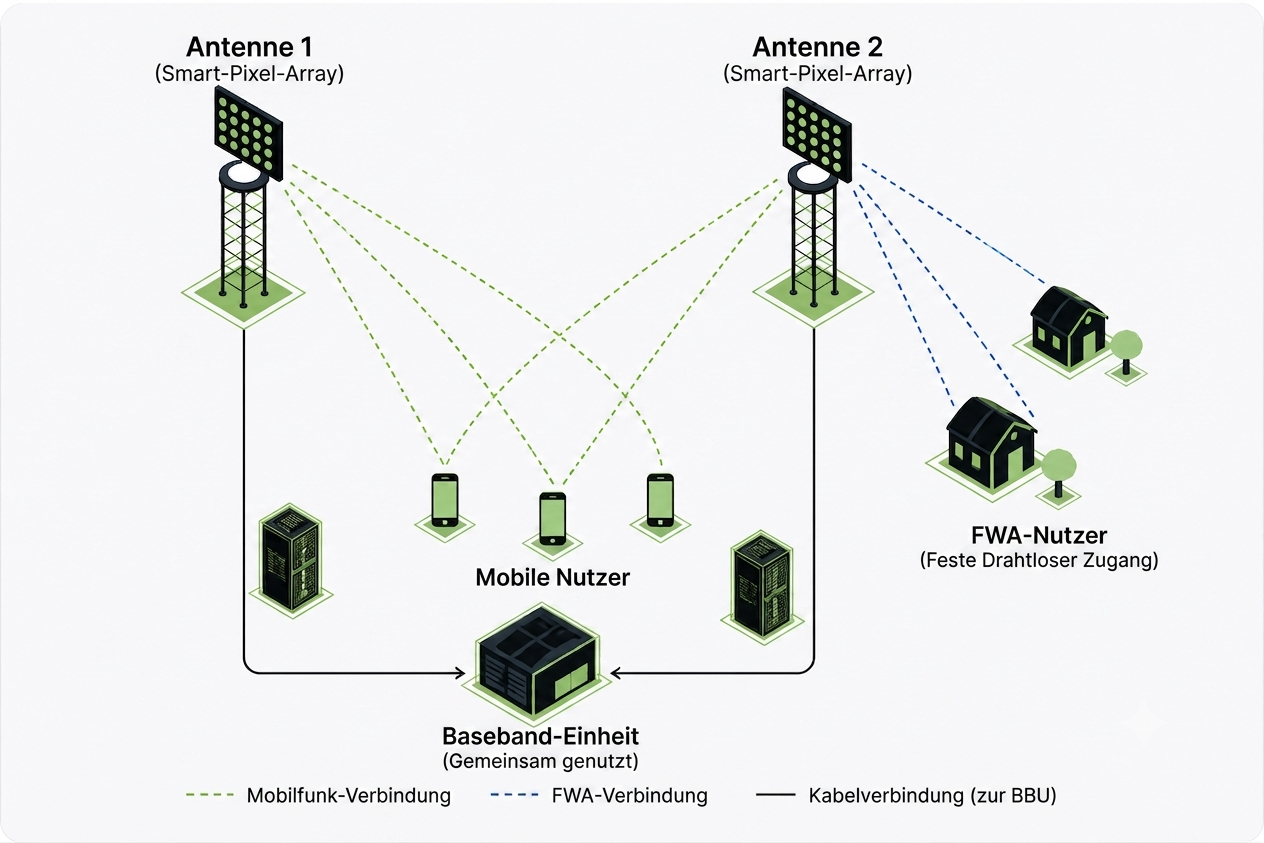
The developed demonstrators will be evaluated in two scenarios: The first scenario is a fixed wireless access scenario, in which the wired last-mile connection is replaced by a broadband wireless connection. The second scenario is a hotspot scenario with beam tracking.
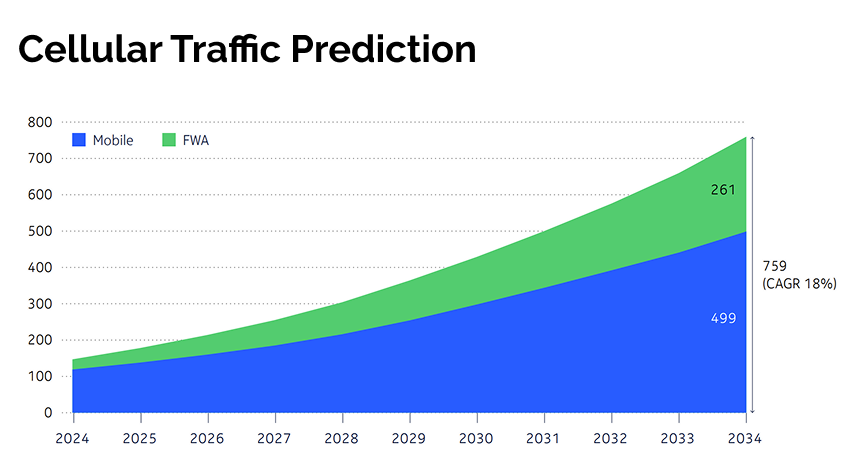
The future 6G mobile communications standard is expected to enable significantly higher data rates than 5G. According to current forecasts, total mobile data traffic will continue to rise through 2030. The International Telecommunication Union has established new requirements for the future 6G standard: In addition to user data rates exceeding 500 Mbit/s, high spectral efficiency and high energy efficiency have also been defined as requirements.
In addition, Fixed Wireless Access (FWA) is becoming increasingly important: Current projections indicate that data traffic generated by FWA will account for up to one-third of the total data volume transmitted via 6G. In this context, the technologies being researched in the project can make an important contribution to future 6G mobile networks.
- Variable bandwidth in the FR3 frequency band
- Scalable Smart Pixel architecture in which up to 16 analog antennas can be controlled by a single digital channel.
- High energy efficiency through op-amp sharing and offset correction in the analog-to-digital converters.
- Distributed antenna arrays and the use of near-field effects to better utilize spatial degrees of freedom in beamforming.